Turquoise (Firoza) Stone Benefits: Astrology, How to Wear and Real vs Fake
Quick answer: Turquoise, known in India as firoza or feroza, is a sky-blue to green-blue stone made of copper and aluminium phosphate. Its traditional benefits are protection (especially while travelling), success, calm communication and goodwill, and its Persian name firouzeh means victory. In Indian astrology there is no single rule: most astrologers link firoza with Guru (Jupiter), some with Shukra (Venus), and it is most often suggested for Dhanu (Sagittarius) and Meen (Pisces). It is traditionally worn in silver, on the index finger, starting on a Thursday morning.
Turquoise is one of the few stones that almost everyone recognises by colour alone. In India it has been worn for centuries, from Mughal-era jewellery to the firoza ring your grandfather never took off. This guide covers turquoise (firoza) stone benefits in tradition and astrology, who it suits, how to wear it, how to tell real firoza from dyed fakes, and how to keep its colour from changing.
What Is Turquoise (Firoza)?
Turquoise is an opaque mineral, a hydrated phosphate of copper and aluminium. Copper gives it the blue, and iron pushes the colour towards green. The brown or black veins you see in many stones are called matrix: bits of the host rock the turquoise formed in. Some people love matrix, others prefer clean, even blue. Neither is "better"; it is a matter of taste.
The English name comes from the old French pierre turquoise, the "Turkish stone", because it reached Europe through Turkish trade routes. The name used across India, firoza or feroza, comes from the Persian firouzeh, often translated as victory or triumph. That meaning is behind a lot of the stone's traditional reputation.
| Property | Turquoise (firoza) |
|---|---|
| Composition | Hydrated copper aluminium phosphate |
| Hardness (Mohs scale) | About 5 to 6, softer than quartz (7) |
| Porosity | Porous; can absorb oils, perfume and water |
| Colour | Sky blue, robin's egg blue, green-blue, often with brown or black matrix |
| Well-known sources | Iran (Nishapur, the classic "Irani firoza"), USA (Arizona, Nevada), China, Egypt (Sinai) |
| Birthstone | December |
| Chakra (crystal tradition) | Throat |
| Linked planets in Indian astrology | Guru (Jupiter) for most astrologers; Shukra (Venus) for some |
| Common treatment | Stabilisation with resin to strengthen soft, chalky turquoise |
Turquoise (Firoza) Stone Benefits
The benefits below come from Persian, Turkish, Indian and wider crystal traditions. They are beliefs that have lasted a very long time, not medical or financial promises.
1. Protection, especially while travelling
Turquoise has a long history as a traveller's stone. In Persian and Turkish tradition it was worn by riders and travellers, and even tied to horses, for safe journeys. Many people in India still give a firoza ring or bracelet to someone moving to a new city or going abroad.
2. Success and confidence
With a name that means victory, it is no surprise firoza is associated with success. People wear it when starting a new job, a business or an important phase of study, as a symbol of winning through.
3. Calm, clear communication
In crystal tradition turquoise is a throat chakra stone, linked with speaking honestly and calmly. Teachers, lawyers, salespeople and anyone who speaks for a living often choose it for that reason.
4. Goodwill and friendship
There is a popular belief that turquoise carries extra goodwill when it is given as a gift. Whether or not you follow that, it makes a thoughtful present, and it is the birthstone for December.
5. A cooling, peaceful colour
Some benefits are simply visual. The soft blue of turquoise feels fresh and calming, and it lifts plain outfits, white cotton and indigo in particular. It is easy to wear every day.
Firoza in Astrology: Which Rashi Can Wear It?
Firoza is not one of the nine navaratna gems. It is treated as a supporting stone (uparatna), and astrologers do not all agree on which planet it belongs to. Most link it with Guru (Jupiter), whose primary gem is yellow sapphire (pukhraj). Others connect it with Shukra (Venus). This is why advice for some rashis differs depending on who you ask.
| Rashi | Common astrological view on firoza |
|---|---|
| Dhanu (Sagittarius) | Most often recommended, as a Jupiter-ruled sign; also the December birthstone |
| Meen (Pisces) | Often recommended, also Jupiter-ruled |
| Kumbh (Aquarius) | Frequently suggested in modern Indian guides |
| Vrishabh (Taurus) and Tula (Libra) | Opinions split: astrologers who link firoza with Venus see it as helpful, others advise caution; check your chart |
| Mesh, Kark, Simha, Vrishchik | Often considered acceptable because Jupiter is friendly to their lords; check your chart |
| Mithun, Kanya, Makar | Check your chart before wearing it as a remedy |
This table summarises general practice, not a personal reading. If you want to wear firoza as an astrological remedy, show your birth chart to an astrologer you trust. If you wear it for its colour and meaning, there are no restrictions beyond normal care.
Turquoise also has a respected place in Persian and Islamic culture, where feroza rings have been worn for centuries, and it is well known in Bollywood: Salman Khan's famous bracelet, widely reported to be a gift from his father, carries a turquoise stone and did a lot to make firoza bracelets popular in India.
How to Wear Firoza the Traditional Way
| Common traditional practice | |
|---|---|
| Finger | Index finger (tarjani), the Jupiter finger; some astrologers suggest the ring or middle finger |
| Hand | Right hand is most common; some traditions suggest the left hand for women |
| Metal | Silver, which also suits the stone's colour best |
| Day | Thursday (Guruvar), in the morning after bathing, preferably during Shukla Paksha |
| Bracelet | Left wrist is popular in crystal tradition for "receiving"; right wrist is equally common in India |
| Weight for remedies | Decided by your astrologer; fashion pieces have no rule |
Who Should Be Careful With Turquoise?
- People wearing it as a remedy without checking. Because astrologers disagree on its planet, Vrishabh and Tula in particular should ask first.
- Swimmers, cooks and anyone who keeps rings on while washing up. Turquoise is porous. Water, oil, soap and chlorine can stain it or change its colour.
- People who knock their hands often. At 5 to 6 on the Mohs scale, turquoise scratches more easily than quartz. A pendant or earrings may suit you better than a ring.
- Anyone hoping it will treat an illness. It is a meaningful stone, not a medicine.
Real vs Fake Firoza: What to Check
Turquoise is one of the most imitated stones in the market. Here is what you are likely to come across:
| Type | What it is | Is it acceptable? |
|---|---|---|
| Natural turquoise | Untreated stone, cut and polished | Yes; usually the most expensive |
| Stabilised turquoise | Natural turquoise strengthened with resin so it does not crumble or change colour quickly | Yes, when the seller tells you; very common |
| Reconstituted turquoise | Turquoise powder pressed with resin into blocks | Only if sold as reconstituted, at a lower price |
| Dyed howlite or magnesite | A white stone dyed blue, with dark "matrix" lines | No, if it is sold as turquoise |
| Glass or plastic | Imitation | No |
Simple checks you can do at home:
- Look at the colour. Real turquoise is rarely perfectly even. Natural variation and slight changes in shade are a good sign.
- Look at the matrix. Natural matrix sits in the stone. On dyed howlite the dark lines often look sunk in, with the blue dye collecting around them.
- Check the drill holes. If beads are white inside the hole and blue on the surface, they are dyed.
- Be wary of very low prices. A genuine turquoise bracelet set in silver cannot cost the same as a glass one.
- Buy from a seller who states what the stone is. Keeta Luxury is a member of the GJEPC; read why GJEPC membership matters and our wider guide on how to identify genuine gemstones.
Why Firoza Changes Colour, and How to Care for It
Untreated turquoise can slowly turn greener over months and years. Skin oils, sweat, creams and perfume seep into the pores and shift the colour. Some people like that aged look, and in Persian tradition a change in colour was even read as a sign. If you want to keep the original blue:
- Put turquoise on last, after perfume, lotion and makeup.
- Take it off for bathing, swimming, cooking and cleaning.
- Wipe it with a soft, dry cloth after wearing. Never soak it, and never use ultrasonic cleaners or chemical dips.
- Keep it out of long, direct sunlight and away from heat.
- Store it in a separate pouch so harder stones do not scratch it.
- For crystal cleansing, use moonlight or incense smoke. Avoid salt water.
Turquoise Ring, Bracelet or Pendant: Which Should You Choose?
- Ring: the traditional choice for astrological wear. Choose a ring if you are following a firoza remedy, and take it off for messy work.
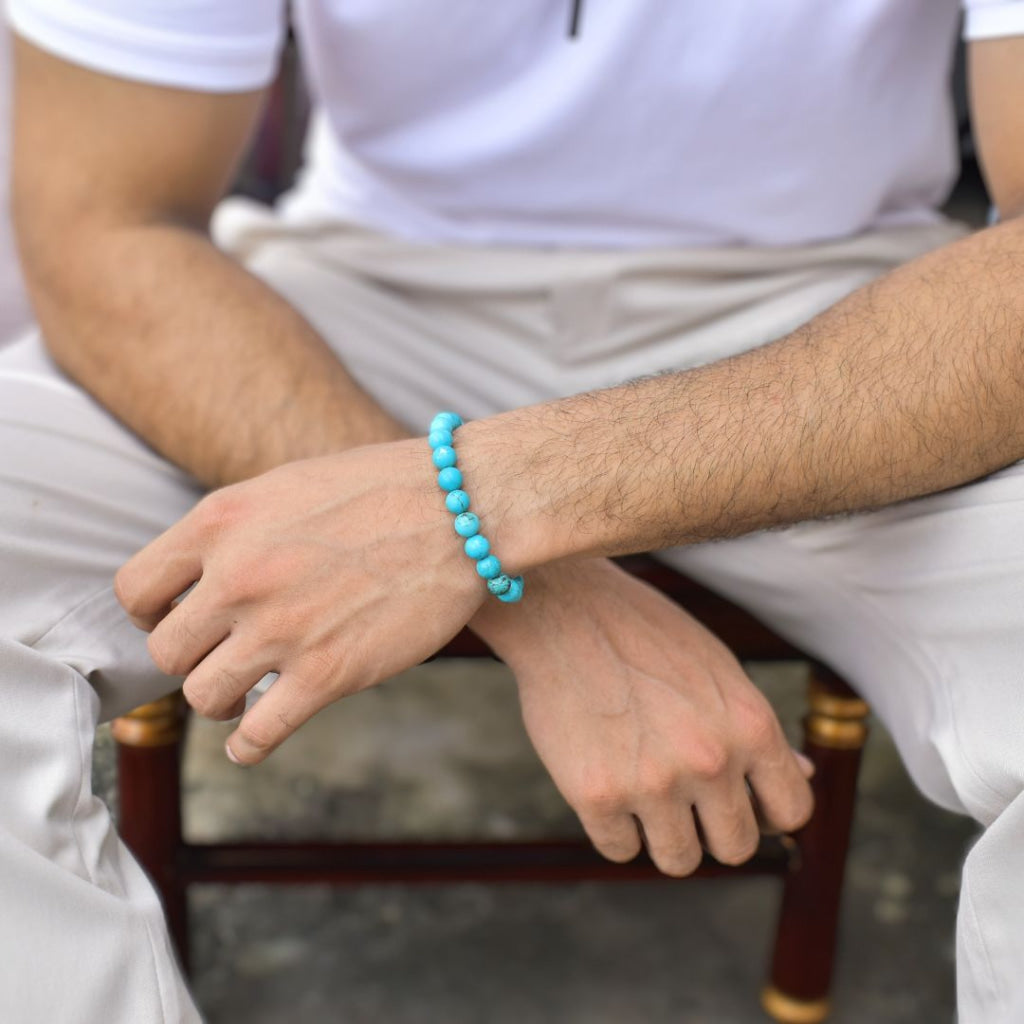
- Bracelet: the easiest everyday option and the most popular with men. Bead bracelets put a lot of turquoise on the wrist at a lower price.
- Pendant or earrings: the safest option for a softer stone, because they rarely get knocked.
Turquoise Jewellery at Keeta Luxury
Our turquoise pieces are handmade in Jaipur, mostly with turquoise from Arizona set in 925 sterling silver.
| Piece | Details | Price |
|---|---|---|
| Basic Turquoise Bracelet | 7 to 8 mm natural turquoise beads from Arizona, men's and women's sizes | Rs. 1,300 |
| Mindful Serenity Turquoise Bracelet | A single line of 4 to 5 mm turquoise rondelles in 925 sterling silver | Rs. 1,400 |
| Eye Serenity Turquoise Bracelet | 6 to 7 mm turquoise beads with a 925 sterling silver evil eye charm | Rs. 1,650 |
| Copper Sky Turquoise Bracelet | 10 mm copper turquoise on a 925 silver chain, also in 14K gold vermeil | Rs. 2,500 |
| Talon Turquoise Ring | 6 x 8 mm oval turquoise in a claw-inspired 925 silver setting | Rs. 4,140 |
| Gaze Guardian Turquoise Ring | 6 mm turquoise in an evil eye inspired, oxidised 925 silver design | Rs. 3,910 |
| Cushion Conquer Turquoise Ring | 10 mm cushion-cut copper turquoise in 925 sterling silver | Rs. 3,795 |
| Trinity Knot Turquoise Necklace | 8 mm turquoise with a Celtic trinity knot pendant, 16 to 20 inch chain | From Rs. 2,875 |
| Mor Pankh Turquoise Earrings | 10 mm turquoise in a peacock feather design, 925 sterling silver | Rs. 3,105 |
Prices are correct at the time of writing. Browse all turquoise jewellery, turquoise rings or turquoise earrings. Every order ships free across India with 14-day returns, and you can order our ring sizing tool before choosing a ring.
Frequently Asked Questions
What are the benefits of firoza stone?
Firoza (turquoise) is traditionally worn for protection, especially while travelling, and for success, calm communication and goodwill. Its Persian name means victory. In crystal tradition it is a throat chakra stone. These benefits come from tradition and belief, not medical or financial evidence.
Which planet does firoza represent?
There is no single answer. Most Indian astrologers link firoza with Guru (Jupiter), and some link it with Shukra (Venus). It is a supporting stone (uparatna), not one of the nine navaratna gems.
Which rashi should wear firoza?
Firoza is most often recommended for Dhanu (Sagittarius) and Meen (Pisces), the Jupiter-ruled signs, and frequently for Kumbh (Aquarius). Vrishabh (Taurus) and Tula (Libra) get mixed advice, so check your chart before wearing it as a remedy.
In which finger should firoza be worn?
Traditionally the index finger (tarjani), the finger linked with Jupiter, usually on the right hand and set in silver. Some astrologers suggest the ring or middle finger instead.
Can I wear turquoise every day?
Yes. Turquoise is fine for daily wear with some care. Put it on after perfume and creams, and take it off for bathing, cooking and swimming, because it is porous.
Why is my turquoise turning green?
Turquoise is porous and absorbs skin oils, sweat, creams and perfume, which can slowly shift its colour from blue to green. Stabilised turquoise changes much less. Keeping it away from liquids and wiping it after wear slows the change.
How can I tell if firoza is real?
Look for natural variation in colour, matrix that sits inside the stone, and blue colour that goes all the way through the drill hole. Be wary of very cheap, perfectly even blue beads, which are often dyed howlite. Buy from a seller who clearly states whether the stone is natural or stabilised.
Is turquoise the December birthstone?
Yes. Turquoise is one of the traditional December birthstones, along with tanzanite and zircon.
Astrological guidance in this article reflects common traditional practice and is not a personal reading. Gemstone meanings come from tradition and personal belief and are not a substitute for medical, financial or professional advice. This guide was written by the Keeta Luxury team in Jaipur, with product details checked against our live store in November 2026.